
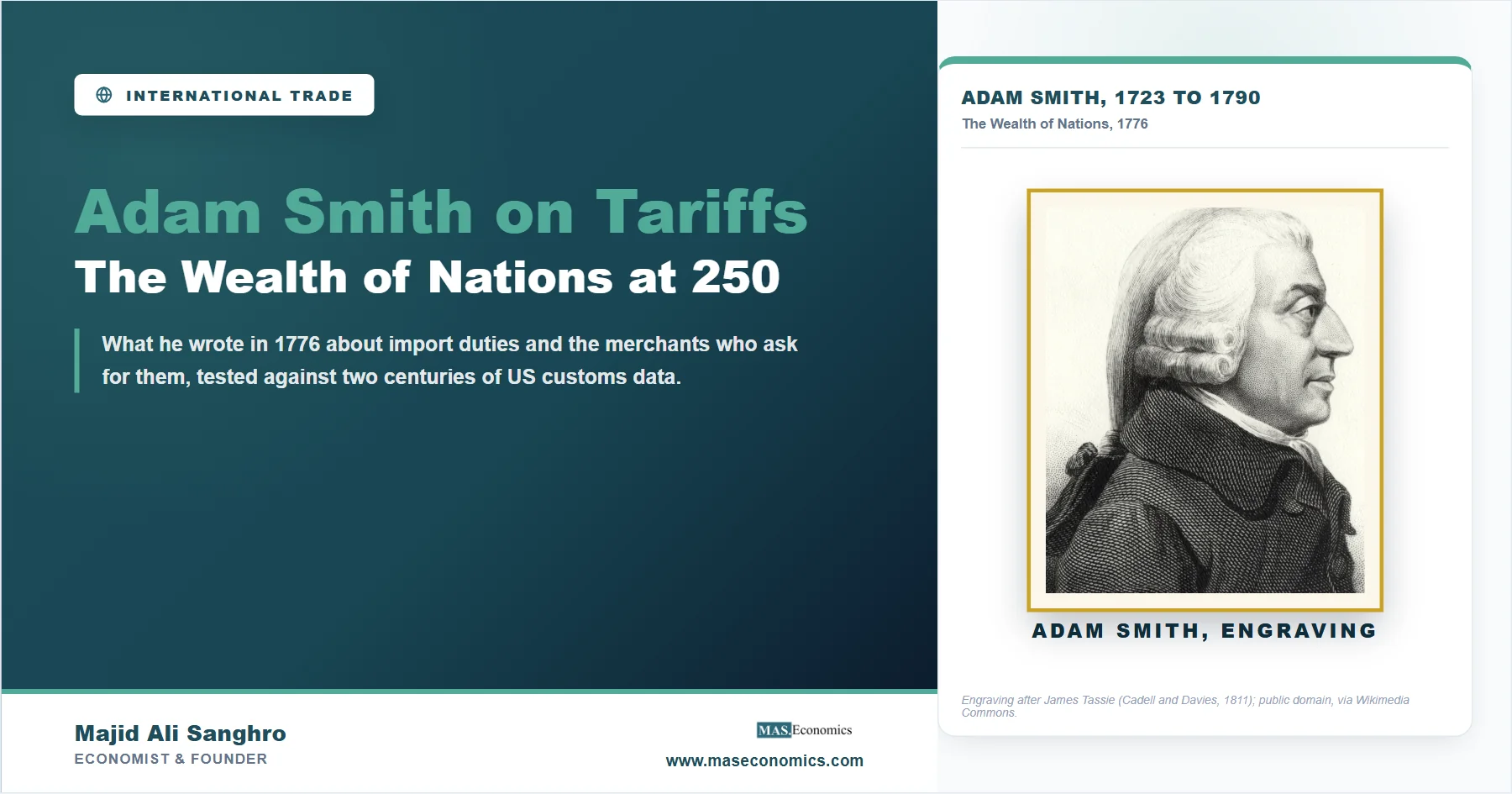
International Economics, Trade policy and tariffs: part 32 of 32
For most of the past half century, the duty on goods entering the United States was small enough for buyers to ignore. In 2025 it stopped being small. Importers paid about 8 cents in duty on every dollar of goods they brought in, against 2.3 cents in 2024, and in the last three months of the year the figure reached 11.3 cents, the highest since 1943. The case against that kind of charge was made at length in a book that turned 250 in March 2026, and Adam Smith on tariffs turns out to be less a slogan for free markets than a set of conditions that the 2025–2026 episode can be checked against.
The Wealth of Nations was published on March 9, 1776. Its author was the son of a customs official and later became a Commissioner of Customs himself. The only time the phrase “invisible hand” appears in the book, it sits in the chapter on restraints upon imports. What Smith wrote in that chapter, and in his warnings about the merchants who ask for protection, can be set against two centuries of American customs records and against the money that moved through the US Treasury in 2025 and 2026.
Smith wrote down the conditions under which he thought a duty was worth its cost. Those conditions, and not anyone’s view of a particular government, are the yardstick used here.
The Customs Officer Who Opposed Import Duties
Adam Smith was born in Kirkcaldy, in Fife, Scotland, in 1723. His father, also named Adam Smith, was Comptroller of the Customs for the Kirkcaldy district, according to John Rae’s Life of Adam Smith, published in 1895.
Smith first made his name as a moral philosopher. The Theory of Moral Sentiments appeared in 1759, and its opening sentence is about sympathy, not markets. Seventeen years later he published An Inquiry into the Nature and Causes of the Wealth of Nations, which Rae dates to March 9, 1776. The Project Gutenberg text of the book runs to about 380,000 words (379,868 by machine count), and its fourth book is where the argument about trade sits.
Two years after publication, in 1778, Smith was appointed a Commissioner of Customs in Scotland by Lord North, Rae records. He died in Edinburgh on July 17, 1790. The man who wrote a classic case against restraints on imports therefore became one of the officials running the system that collected duties on them. The contradiction is smaller than it looks. Smith did not argue that a state should collect nothing at the border, and the tariff chapter itself allows exceptions. He argued about which duties served the nation and which served a narrow group inside it.
The Invisible Hand Sits in the Tariff Chapter
The phrase most often attached to Smith’s name is rare in his own writing. A machine count across three of his texts finds “invisible hand” three times, once in each: in The Wealth of Nations, in The Theory of Moral Sentiments (Part IV, Chapter I), and in his essay The History of Astronomy, published after his death in Essays on Philosophical Subjects, where it refers to “the invisible hand of Jupiter”. Student notes of his lectures were not part of the count.
The single use in The Wealth of Nations is in Book IV, Chapter II, whose full title is “Of Restraints upon Importation from Foreign Countries of such Goods as can be Produced at Home.” That is the tariff chapter. Smith is describing an owner of capital who prefers to invest at home rather than abroad:
“By preferring the support of domestic to that of foreign industry, he intends only his own security,” Smith wrote, and in doing so he is “led by an invisible hand to promote an end which was no part of his intention.”
The argument in context is narrower than the slogan. Investors already lean toward home industry for their own safety, so a law pushing them further in that direction is unnecessary, and where it overrides their judgment it is costly. The next sentence carries a qualifier that is often dropped: “By pursuing his own interest, he frequently promotes that of the society more effectually than when he really intends to promote it.” Frequently, not always. The broader idea, how prices coordinate millions of separate decisions, is the subject of the article on the invisible hand. Here the point is where the phrase lives. The image that now stands for Smith’s whole economics was written in an argument about import duties.
The Household Rule Behind Free Trade
The core of Smith’s case fits in two sentences from the same chapter. The first is about families: “It is the maxim of every prudent master of a family, never to attempt to make at home what it will cost him more to make than to buy.” The second applies it to countries: “If a foreign country can supply us with a commodity cheaper than we ourselves can make it, better buy it of them with some part of the produce of our own industry, employed in a way in which we have some advantage.”
He then closes the gap between the two with a line that later economists would build on: “What is prudence in the conduct of every private family, can scarce be folly in that of a great kingdom.” A tailor does not make his own shoes, and a shoemaker does not make his own clothes. Each buys what others make more cheaply and pays with what he makes best. Smith’s version rests on one country being better than another at making a particular good, the idea now called absolute advantage. David Ricardo later showed that trade pays even when one country is better at making everything, as long as the costs differ in relative terms, the result set out in the Ricardian model of trade.
Smith was writing against a school of thought that measured a nation’s wealth by the gold and silver it held and therefore tried to export more than it imported. Book IV, Chapter I names the error: “That wealth consists in money, or in gold and silver, is a popular notion.” For the mercantile writers, an import was a loss of treasure. For Smith, wealth was what a country could produce and consume, and an import bought cheaply was a gain. Where that argument sits among the later schools is traced in the article on the schools of economic thought.
Translated into the 2025 numbers, the household rule is simple arithmetic. A duty is a tax on imported goods collected at the border, as the guide to what a tariff is explains. On $100 of goods brought into the United States, duties took about $2.30 in 2024 and about $8 in 2025. The goods did not change. What changed was the price of buying them from the cheaper supplier, which is exactly the cost Smith’s prudent master of a family was trying to avoid.
Smith’s Sharpest Words Were for Merchants
The Wealth of Nations is often read as a defense of business. On trade policy it reads closer to the opposite. Smith’s harshest sentences are aimed at the merchants and manufacturers who asked governments for protection, and he told his readers how to treat their proposals. In Book I, Chapter XI, he wrote that any new law or regulation of commerce proposed by this group “ought always to be listened to with great precaution,” because it comes from “an order of men, whose interest is never exactly the same with that of the public.”
Book I, Chapter X has his best-known line on the subject: “People of the same trade seldom meet together, even for merriment and diversion, but the conversation ends in a conspiracy against the public, or in some contrivance to raise prices.” Two centuries later the line still described real cases. In October 1996 the US Department of Justice announced that Archer Daniels Midland had agreed to plead guilty and pay a $100 million criminal fine for fixing the prices of lysine and citric acid, which the department called the largest criminal antitrust fine ever at the time.
Smith’s view of pricing power links the two subjects. “The price of monopoly is upon every occasion the highest which can be got,” he wrote in Book I, Chapter VII. A duty on a foreign rival’s goods does not create a monopoly in the strict sense, but it moves a domestic producer some way toward the market power described in the article on what a monopoly is: the cheaper competitor now costs more, and the home producer can charge more before losing the sale. Smith expected the request for that shelter to come from the producers who would gain from it.
Against those requests he set a single test, written in Book IV, Chapter VIII: “Consumption is the sole end and purpose of all production; and the interest of the producer ought to be attended to, only so far as it may be necessary for promoting that of the consumer.” For Smith a trade policy is judged by what it does to the people who buy the goods. A policy that helps a producer at the buyer’s expense fails, however well the producer argues for it.
The Two Exceptions Smith Wrote Down
Smith was not against every duty, and the two exceptions in the tariff chapter that matter most for 2026 are stated in his own words. The first is national security. Writing about England’s act of navigation, a law on shipping, he concluded: “As defence, however, is of much more importance than opulence, the act of navigation is, perhaps, the wisest of all the commercial regulations of England.” A duty that protects an industry the country would need in a war can be worth its cost, on Smith’s terms, even though it makes the country poorer in ordinary times.
The second is retaliation, and here Smith attached a condition. “There may be good policy in retaliations of this kind, when there is a probability that they will procure the repeal of the high duties or prohibitions complained of.” A retaliatory duty is a bargaining tool, justified only by its chance of getting a foreign duty removed. Without that chance, he judged it a mistake: “it seems a bad method of compensating the injury done to certain classes of our people, to do another injury ourselves, not only to those classes, but to almost all the other classes of them.”
Later economics added a case Smith did not make. A very large buyer can sometimes push down the prices foreign sellers charge, so that part of a duty is paid by them rather than by its own consumers. The conditions for that gain, and its size, are set out in optimal tariff theory. Two features of the result keep it close to Smith’s worry. The gain comes out of a trading partner’s income, and it disappears if the partner retaliates, which brings the argument back to his retaliation test.
Two Centuries of American Duties
The United States offers the longest official record against which to read these tests. For 1821 to 1890 the ratio of duties to the value of all imports comes from the Census Bureau’s Historical Statistics of the United States. For 1891 to 2024 it comes from the US International Trade Commission’s table of US imports and duties. For 2025 and 2026 it is computed from the Bureau of Economic Analysis figures for customs duties and imports of goods. Figure 1 joins the three.
The infographic turns the duties into coins: of every dollar of goods brought into the United States, 57 cents went to the customs house in 1830, 20 cents in 1932, 10 in 1946, about 1 in 2008 and 2.3 in 2024, before the new tariffs lifted it to 11 cents at the end of 2025.
Infographic. The duty on every import dollar

Figure 1. US Customs Duties as a Share of the Value of All Imports, 1821–2026
Source: US Census Bureau, Historical Statistics of the United States, Colonial Times to 1970 (1821–1890; seven years missing from the scanned table are bridged by the line); US International Trade Commission (1891–2024); US Bureau of Economic Analysis, customs duties divided by imports of goods, quarterly data at seasonally adjusted annual rates, via the Federal Reserve Bank of St. Louis (2025, and January to June 2026). Annual ratios; the BEA basis differs slightly from the USITC basis. MASEconomics calculation.
The early republic taxed imports heavily. In 1830 duties equaled 57.3 percent of the value of everything imported, the highest reading in the record: 57 cents of duty on each dollar of foreign goods. From 1831 to 1913, in 83 percent of the years with a verified figure, duties took between a fifth and a half of import value. The ratio fell during the First World War, rose again in the interwar years and reached 19.6 percent in 1932, in the depth of the Depression.
After 1945 it fell almost without a break. It was 10.3 percent in 1946 and 7.9 percent in 1947, below 4 percent in every year from 1979, and 1.2 percent in 2008, the lowest reading in the record. By 2024 it was 2.3 percent. Then, in a single year, it more than tripled. On the BEA basis duties were 8.03 percent of goods imports in 2025, the highest annual ratio since 1946, and 11.3 percent in the fourth quarter, the highest since 1943. In the first half of 2026 the ratio averaged 8.83 percent, with the second quarter at 8.2 percent.
| Period | Duties as a share of imports | Duty per dollar of imports | Source |
|---|---|---|---|
| 1830 (peak of the record) | 57.32% | 57 cents | Census, Historical Statistics |
| 1932 | 19.6% | 20 cents | USITC |
| 1946 | 10.3% | 10 cents | USITC |
| 2008 (low of the record) | 1.2% | 1 cent | USITC |
| 2024 | 2.3% | 2.3 cents | USITC |
| 2025 | 8.03% | 8 cents | BEA |
| Fourth quarter of 2025 | 11.3% | 11 cents | BEA |
| January to June 2026 | 8.83% | 9 cents | BEA |
|
|
|||
Source: US Census Bureau, US International Trade Commission and US Bureau of Economic Analysis, as in Figure 1. The BEA ratio for 2024 is 2.56 percent against the USITC’s 2.3 percent, so readings on the two bases are close but not identical.
The same rate also reaches further than it once did. The World Bank puts US trade, exports plus imports, at 10.8 percent of GDP in 1970 and 25.0 percent in 2024, after a peak of 30.8 percent in 2011. Trade now makes up a share of the economy more than twice as large as in 1970, so a duty of 8 cents on the import dollar touches more of it.
What the Duties Collected and Returned
A duty is a tax before it is anything else, and the Treasury’s books show the scale of the change. The Monthly Treasury Statement records gross customs receipts of $7.9 billion in January 2025 and $33.1 billion in October 2025, more than four times as much in a single month. Over the calendar year, gross customs receipts came to $273.8 billion, against $86.1 billion in 2024. That is about $750 million a day, and 3.2 times the previous year’s total (Figure 2).
Figure 2. US Customs Receipts by Month, Gross and Net of Refunds, January 2023 to August 2026
Source: US Department of the Treasury, Bureau of the Fiscal Service, Monthly Treasury Statement, customs duties, gross and net receipts by month, January 2023 to August 2026. Refunds are gross minus net receipts. MASEconomics calculation.
On February 20, 2026, the Supreme Court decided Learning Resources, Inc. v. Trump (No. 24-1287) and held that the International Emergency Economic Powers Act does not authorize tariffs. In the months that followed, the net line in Figure 2 fell below zero. Net customs receipts were negative in May, June and July 2026, reaching minus $25.6 billion in June. From May to August 2026, refunds totaled $115.1 billion, more than all the customs duties the United States collected in the whole of 2024.
Gross collections fell from their peak but stayed well above their earlier level, between $21.9 billion and $24.8 billion a month from May to August 2026, more than three times the 2024 monthly average. Refunds go back to the importers who paid the duty. They do not reach back to every price that rose while the duty was in force, which is why the question of who carried the cost matters more than the question of who wrote the check.
Who Carried the Cost in 2025
Smith’s consumer test asks where the cost of a duty lands. The Bank for International Settlements gives the clearest estimate so far. In its Annual Economic Report 2026, it finds that the US firms most affected by the tariffs absorbed about two thirds of the cost increases through lower profits and passed about one third on to consumers.
Put in household terms, of every $3 of extra cost that reached those firms, about $1 showed up in prices paid by American buyers and about $2 came out of the firms’ own margins. Lower profits are not a cost that vanishes. They belong to the firms’ owners and shareholders, and they are the pool from which firms pay for new equipment and hiring. The mechanics of that split, and why it depends on how easily buyers and sellers can switch, are worked through in the article on who pays the tariff.
Two limits apply to the estimate. It covers the most affected firms, not every importer in the country. And it describes how the cost that reached those firms was divided, not how much foreign exporters absorbed by cutting their own prices before the goods arrived. On what it does measure, both shares fall on Americans: one third on buyers and two thirds on businesses. Read against Smith’s sentence that consumption is “the sole end and purpose of all production”, that is the outcome his test was written to catch. The wider sequence of the episode is covered in the account of the global tariff war of 2025–2026.
How a US Tariff Reaches Other Economies
The United States is the buyer in this story, and every dollar of duty attaches to a sale by a producer somewhere else. The $273.8 billion collected in 2025 was levied on goods made outside the country. When a duty raises the price an American buyer pays, some of those orders shrink or move, and the lost sale belongs to a factory, a farm or a shipper in another economy.
That exposure is larger abroad than at home. The same World Bank series that puts US trade at 25.0 percent of GDP in 2024 puts trade for the world as a whole at 56.7 percent of world GDP. For the world economy as a whole, trade is more than twice as large a share of output as it is for the United States, so a shock to American demand weighs more, relative to their size, on the economies that sell into it than on the economy that imposes it.
Two channels carry the effect further. The first is rerouting. When one large market raises duties on some suppliers and not others, buyers shift to the suppliers that face lower duties, and goods that no longer sell in the United States look for other markets, the shift economists call trade diversion. The sources used here do not measure how much trade was rerouted in 2025 and 2026, so the size of that effect is left open. The second channel is retaliation, and it is the one Smith described. A partner that answers with its own duties raises prices for its own buyers, and on his reasoning does “another injury” at home to answer the first.
Smith saw commercial rivalry between nations as something worse than a pricing problem. In Book IV, Chapter III, he wrote: “The capricious ambition of kings and ministers has not, during the present and the preceding century, been more fatal to the repose of Europe, than the impertinent jealousy of merchants and manufacturers.” He was writing about Europe in his own century. The mechanism he named, trade policy written for one group of producers and answered in kind abroad, is not tied to any century.
Smith’s Tests Against the 2025–2026 Record
Asking what Smith would have said about 2026 is guesswork. Asking how the record scores against the tests he wrote down is not. Table 2 applies each one, with the evidence available from the sources above and a reading that stays within what that evidence shows.
| Smith’s test | Where he wrote it | What the record shows | Reading on his terms |
|---|---|---|---|
| Buy where it is cheaper | Book IV, Chapter II | Duties rose from 2.3 cents to about 8 cents per import dollar between 2024 and 2025 | A broad duty fails this test by design, since its purpose is to change where goods are bought |
| The consumer comes first | Book IV, Chapter VIII | Most-affected US firms absorbed about two thirds of cost increases and passed about one third to consumers | Fails: both shares of the measured cost fall on domestic buyers and businesses |
| Defense outranks opulence | Book IV, Chapter II | Not measurable from customs totals | Passes only for duties whose purpose is defense, judged one product at a time |
| Retaliate only if repeal is probable | Book IV, Chapter II | The sources here do not record which foreign duties were removed | Open: settled by whether foreign duties on US goods came down |
| Treat merchants’ proposals with suspicion | Book I, Chapter XI | Not measurable from customs totals | Not scored: a rule about who asks for protection, not about the rate |
|
|
|||
Source: The Wealth of Nations (1776), book and chapter as shown; US International Trade Commission; US Bureau of Economic Analysis; Bank for International Settlements, Annual Economic Report 2026.
Two of the five tests can be scored, and on both the record fails Smith’s standard. Two cannot be scored from aggregate data at all, because they depend on the purpose of particular duties and on what trading partners did in response. One is a rule about how to listen to the people asking for protection, which no customs series can measure. The fair summary is that Smith’s case against broad duties fits the measured costs of 2025, while his exceptions remain open questions that the totals cannot answer.
What 250 Years of Data Cannot Prove
The long record invites a stronger claim than it supports. The Maddison Project Database puts output per person in Britain at $2,962 in 1776 and $38,407 in 2022, 13 times higher, and in the United States at $2,419 in 1775 and $58,487 in 2022, 24.2 times higher, both in 2011 international dollars. The Maddison Project Database 2023 shows the scale of what specialization and trade have been part of. It does not show that trade policy caused it. Machines, energy, science and schooling all grew over the same 250 years.
The record cuts the other way too. From 1830 to 1913, when American duties took between a fifth and a half of import value in most years, output per person in the United States rose 3.3 times by the Maddison estimates, against 2.3 times in Britain. That does not show the duties caused the faster growth, any more than the 2008 low proves that low duties caused anything after it. Many other forces moved at the same time. Correlation in either direction is not proof.
Three narrower limits apply to the figures in this article. The BIS estimate covers the most affected firms, not the whole economy. The 2025 and 2026 ratios are on the BEA basis, which ran slightly above the USITC basis in 2024. And seven years between 1827 and 1885 are missing from the scanned Census table and are bridged in Figure 1 rather than estimated.
Books by and about Adam Smith
Smith’s own book is the place to check every claim tested above, and two modern books place it in its time and in the long American record on duties.

The Wealth of Nations
Adam Smith (Modern Library, Cannan edition)
Smith’s 1776 book in the edition carrying Edwin Cannan’s scholarly notes, the text most often cited. Book IV holds the chapters on restraints upon imports that this article tests, and it suits a reader willing to take the argument in Smith’s own words.

The Worldly Philosophers
Robert L. Heilbroner
Heilbroner’s group biography of the great economists gives Smith a full chapter and sets The Wealth of Nations in the Scotland that produced it. It suits a reader who wants the context before opening the original.

Clashing over Commerce
Douglas A. Irwin
Irwin’s history of American trade policy is the most detailed account of the duties traced in this article, from the colonial era to the present. It suits a reader who wants the long record behind the 2025 tariff decisions.
MASEconomics Explains
Mercantilism
The view, dominant before Smith, that a nation grows rich by accumulating gold and silver, so it should export more than it imports. Smith rejected it, arguing that wealth is what a country can produce and consume.
Absolute Advantage
The ability of one country to produce a good with fewer resources than another. Smith’s case for trade rests on it: buy abroad what others make more cheaply, and pay for it with what the country makes best.
Tariff Incidence
The question of who actually bears the cost of a duty, whatever the law says about who pays it. The cost can fall on domestic buyers, on importing firms’ profits or on foreign sellers who cut their prices.
Retaliatory Tariff
A duty imposed in response to a trading partner’s duty. Smith accepted it only when there was a probability that it would win repeal of the foreign duty, and otherwise judged it a second injury to the country that imposes it.
Conclusion
Adam Smith on tariffs is a case built on household arithmetic and a distrust of the producers who ask for protection, written in the same chapter as his only use of “invisible hand” in The Wealth of Nations. He allowed duties for defense and for retaliation that had a probability of winning repeal, and he judged every other trade policy by what it did to consumers.
The American record gives his tests real numbers to work on. Duties fell from 57.3 percent of import value in 1830 to 1.2 percent in 2008, then rose from 2.3 percent in 2024 to 8.03 percent in 2025, the highest since 1946. Gross customs receipts reached $273.8 billion in 2025, and after the Supreme Court’s February 2026 ruling, refunds of $115.1 billion between May and August exceeded everything collected in 2024. The BIS finds that the most affected US firms absorbed about two thirds of the cost increases and passed one third to consumers.
On the two tests the data can score, the record fails Smith’s standard. On defense and retaliation, the aggregate figures cannot give a verdict.
Frequently Asked Questions
What did Adam Smith say about tariffs?
In Book IV of The Wealth of Nations (1776), Smith argued that a country should buy from abroad whatever a foreign country can supply more cheaply than it can make at home, just as a prudent household does not make what it can buy for less. He held that restraints on imports serve particular producers at the expense of consumers, whose interest he called the sole end of production.
Was Adam Smith against all tariffs?
No. In the same chapter he accepted duties needed for defense, writing that defense is of much more importance than opulence. He also accepted retaliatory duties, but only when there was a probability that they would win repeal of the foreign duties complained of.
Where does the invisible hand appear in The Wealth of Nations?
Once, in Book IV, Chapter II, the chapter on restraints upon the importation of goods that can be produced at home. In the three texts counted for this article, the phrase appears three times in all: once in The Wealth of Nations, once in The Theory of Moral Sentiments and once in his essay The History of Astronomy.
Did Adam Smith work in customs?
Yes. In 1778, two years after The Wealth of Nations appeared, he was appointed a Commissioner of Customs in Scotland. His father had been Comptroller of the Customs for the Kirkcaldy district, according to John Rae’s 1895 biography.
Who paid for the 2025 US tariffs?
The Bank for International Settlements estimates that the US firms most affected absorbed about two thirds of the cost increases through lower profits and passed about one third to consumers. The estimate covers the most affected firms and does not measure how much foreign exporters absorbed by cutting their prices.
Thanks for reading! Smith took up a customs post two years after his book appeared, and two and a half centuries on, the customs ledger is still the fairest place to test what he wrote. Happy learning with MASEconomics
Nuoroda į informacijos šaltinį